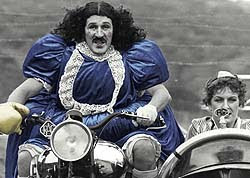
Translation from the September 1979 issue of MusicMaker. Since the photos are stock material I won't bother with posting them.
I attempted to translate the "style" in which it is written: unfortunately, the people at Music Maker are more professional musicians than
actual writers, so the language is crooked. Plus why Chopin gets honoured as innovator is as doubtful as why the author decides to put the (doubtful)
in when describing the honour.
Perfection up to the highest degree
FRANK ZAPPA
Few people can demand the honour that is Frank Zappa's. Through the years he made music in such a consistent way, is the line in his deeds so
chrystal clear, that we can truly speak of a messiah in pop music. An innovator, a reformer, an investigator, an avant-gardist. A barrel full of
contradictions. From the first album "Freak Out" on, Zappa made his mark in popular music. I bet that in forty or fifty years, he'll
get the same (doubtful) honour as Liszt, Chopin, Rachmaninoff, Stockhausen, Cale and Glass. To name a few.
Because of feduciary reasons, Zappa always had to work in the margin. The image of the musician with a bungalow in Hollywood and his own pool
doesn't apply to him {BB: Zappa did live in Hollywood and had a swimming pool}. Because his music needs a complex execution on the side of the
musicians and his works never got in the charts, there were projects in which more money was put in that came out (200 Motels) and circumstances
unforeseen, Zappa stays in that respect a sort of Joe Average with Gyro Gearloose ideas in popular music. To the superficial ear.
Because in history of pop music there have been a number of unnoticeable people who caused revolutions and innovations in the trade: Jack Nitsche,
Phil Spector, Todd Rundgren, Billy Scymzyck and Zappa. The producers. The people with a vision. On his latest double album (sheik Yerbouti) Zappa
proves clearly he's the right man on both sides of the double glazed window.
Making music is not just waiting in a studio for the sign of the technician; in Zappa's world it's anticipating, thinking ahead, using the
studio as instrument. That's what this conversation is about. And about problems in society, lack of money and unforseen circumstances.
"A year and a half ago, there was a breaking point in my career, aside from the musical end. In the sense that circumstances that had nothing to
do with music an sich, forced me to think about what I was doing. It had always been on the edge money-wise, but before I managed to make ends meet.
To summarize: first there was a deal with my record company (Warner Brothers) who had taken over the rights from the late label Verve, who'd been
my contractor from the start, that was suddenly ended according to the letters in the deal.
Well, they did come with a new contract in which my freedom as composer and thinking musician was cut so short that I might as well have gotten into a
disco band. They made a judgment error: I can also handle meetings and interpret marketing results from accounting executives. I learnt that with 200
Motels. I want, no demand, absolute creative freedom. If not they can get the gas from me. To cut a long story short, it became a hassle in which I
had the feeling I had to comb my hair back, wear a smart suit and walk up and down Wall Street with a briefcase. A legal money fight. At the same time
we were doing preparations for a tour with the Mothers, the whole thing was planned, and one day I went to the warehouse where all our equipment, the
P.A., the light, you name it, was stored, and was confronted with a completely empty interior. They even took the TL tubes out of the fittings. There
was nothing anymore. I thought it had been stolen. Later it turned out that the owner of the warehouse sold everything, including everything inside.
My stuff. A paper war followed that is still lasting to this day: also becuase the insurance refuses to pay because according to the fine print in the
contract,
it is not stolen. It was a cold shower.
Eventually CBS made a fine proposition: no hooks, no frills. Optimal freedom, and that's what I want.
Few people know that Zappa, produced all of his 23 records save two, and besides that still found time to produce Alice Cooper (Pretties for You),
Captain Beefheart (Trout Mask Replica) and Grand Funk Railroad (Good Singin', Good Playin') of desired and paid production. Next to his work
on extensive notations of his pieces into arrangements for string- and wind ensembles. A busy bee, which you can tell from the fact that he
doesn't do just producion. Apart from the label of satiric, which is put all too often on him, he could also be labeled as dogmatic. Freak Out
wasn't just the record of a chaotic who would make the earth fall from its axis. It was a well-aimed debut of a man who was all too sure on what
he wants to achieve in pop music. Perfection to the highest degree. Creepily American and educational. "I always looked up to recording studios,
all those people who knew exactly which button to turn to get the desired effect. Until I got to deal with it. Turned out that, in my own studio at
home, the den, I could get everything done a lot better. I experienced that with making Freak Out. The technicians and the producer were just sitting
there because they were being paid for it. If you get the message. During the recording of We're Only In It For The Money, I made good ol'
Tom Wilson, bless his soul, completely crazy. At one point he said: "If you know it so well then you do it yourself" and slammed the door
behind him. From that point on, I was the producer. With all advantages and disadvantages I had no idea about. A good thing too. In comparison to now,
the early recordings were done in bad conditions: the first two albums were recorded on 4 tracks, WOIIFTM was on 8 tracks but in a primitive studio
and Hot Rats was made on a home-built 16 track machine in the same studio where Freak Out was made. The only thing you aimed for in those days was to
get your music as straight as possible on tape. Back then you couldn't use a studio as creative building block. It was more of a method to
reproduce your creation as adequately as possible. The real use of the studio as instrument came much later. I had certain theories I wanted to test
at the time, the choice between experimenting and recording what we were doing. For financial reasons we were forced to the last one.
On his later albums, from the third on, Zappa got the opportunity to prove what he could do in a studio. From that point on, the production is in his
hands. That has to do with the fact that he sees himself as a creating musician, to use the term: more as a composer than as a practicing musician. A
process in which the studio, the recording process, is playing an ever more important part. His place behind the buttons is as important, if not more
important, than the musician on the other side of the sound proof glass. Looking for the perfect production, Zappa discovered a method that is very
logical, even the base of making music: playing live. The latest record Sheik Yerbouti is a good example. "I record all those performances live,
whenever possible. Later I duck into the studio with it and overdub various things. I have a very good reason to record live: the musicians play much
more driven and put more into it. You get more "balls" in the music. Crosstalk is not as much a problem as is assumed, and in case anything
seeps through I squeeze out all that junk in the studio, quite simple. For as far as the studio is concerned: the placement of instruments and amps is
not important for me in acoustic context. What I'm interested in: how good are the monitors? What possibilities does the mixing board have? How
quiet is the mixing board? What extra equipment is present and what is charged for the use of them? To me, the studio is one part of the whole and the
best method is to get in with as much base material you can get. It's not right to depend yourself on the studio. Like: "Next week I'm
going to that studio next week to make my record and use whatever is there." That's not how it works. The studio then uses you, rather than
you use the studio. The studio is where you finish your work, not where you start."
On his latest double album Sheik Yerbouti, a lot of Zappa's claims are fleshed out. The core material of the album is recorded live, as starting
point for the rest of the work. "Rubber Shirt" is a good example. Of that, the bass was recorded at a performance in Göteborg, Sweden, it
was split from a 4-track TEAC recording. This theme was in 4/4 time signature overdubbed on guitar and this was put together with parts of another
performance in Sweden years later, so the resulting song is made of instrumental interaction that never existed in real life. Zappa likes this kind of
pranks and it fits in his concept that technique is not static data.
"Sometimes I write down pieces, let compositions be written out. Often things are created from a directed coincidence. Sheik Yerbouti was born
partly that way. You always need to pay attention to one thing: the difference between rock & roll (here used more to describe the US popular
music on the whole) and all other music is not in rehearsal, lyrics or chords: no, it's in the timbre. That's the key. You can take the
chords of any popular rock & roll song, like Louie Louie, and transcribe it for accordeon, harp and oboe and it's not rock & roll
anymore. On the other hand you can take music from the other field and arrange it for a few fuzz guitars, a loud bass and a drum kit with pumped up
tom toms, and Jesus Christ, then you suddenly have rock & roll. The timbre causes the event. I don't mean the specific sound of my guitar or
my way of recording. The timbre I'm talking about is in all rock & roll, and as far as my guitar goes, it's a Gibson SG and if you want
to hear the same tone you just have to put it in a Pignose amplifier. But if you want the same audio sensation, take a spacious room so you can move
and put your amp as loud as possible. The impressive part of rock & roll and the matching guitar sound, is the physical pressure you experience.
In the studio I record my guitar in the same way as on stage: volume maxed out so the microphone captures the same distortions and the same pressure,
or at least the impression of it. You could never get that sound from a Pignose. It's a kick to let an electrical guitar sing, isn't
it?"
In interviews Zappa has his favourite topics. "Music must be the bearer of a lifestye." "Pop music can also be approached
analytically." Etcetera etcetera. Those who are interested should look up older interviews. Though there is one subject that is always brought
up, up to obnoxious levels.
The moola. Or the lack of moola and why an integer musician never gets rich on music alone. His elogies are also on too small budgets he got for his
records, and that caused him to be restricted to unorthodox production techniques. (well, restriction... I think Zappa is freer in his recording
methods than any other artist) One example:
"When we made the first deal with Warner Brothers, we got $22,500 to $27,500 per album, and that increase was based on collective bargaining by
the musician's union. For that amount, nobody can make a record. Later it became $60,000 per record. In the days that the average group got
$250,000. Imagine."
Zappa is still not satisfied with his financial arrangements with the record company, although his CBS contract is more satisfying. Of course, someone
with extravagant projects like 200 Motels needs to shed a feather here and there. Zappa is the recalcitrant elder in the pop music scene. A sort of
musical Einstein in his deeds. A genius with strange methods and unimitable ideas. But it's interesting to learn about it, which we just did.
-Bert Jansen.

 Search
 FAQ
FAQ Member List
 Today's Posts
 Stats
Stats Board Rules