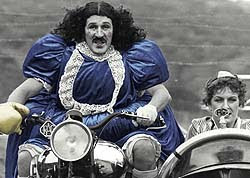
Happy birthday Cal Schenkel!

 facebook finding:
Calvin "Cal" Schenkel (born January 27, 1947)
facebook finding:
Calvin "Cal" Schenkel (born January 27, 1947)
The beginning of Cal Schenkel’s story reads like a rock’n’roll fantasy that Cameron Crowe forgot to film. In 1966 he was a nineteen-year-old kid
hitch-hiking in LA when a jeep full of girls picked him up and dropped him at a rock’n’roll recording session. The rock bandleader was Frank Zappa and
the record was his debut: Freak Out! by The Mothers of Invention. The two men met in passing but wouldn’t see each other again for another year.
By the spring of 1967 Schenkel was back in the Philadelphia area, where he was born and raised. Zappa, who had art directed the first two Mothers
album covers himself, was looking for an artist to take over, and Schenkel’s then-girlfriend, a Zappa collaborator, showed the musician some of the
artist’s work. Schenkel and Zappa got together in New York, where the Mothers had a lengthy performance residency, and Zappa hired him immediately to
work – in quick succession – on some advertisements for the forthcoming Absolutely Free record, on the live light show and then the Sgt. Pepper’s
parody cover for We’re Only In It For the Money, which was designed to Zappa’s satirical specifications. A college drop-out with just a semester of
art courses to his credit, young Cal Schenkel gradually became Zappa’s ‘art engineer’, taking up residence first in Zappa’s New York apartment,
playing photographer on the band’s European tour and then, in the summer of 1968, moving into a studio built into a eucalyptus tree attached to the
main house on Zappa’s estate in Los Angeles. Zappa was aware of the possibilities of art and rock fairly early on, and employed Schenkel to create a
unified Zappa-centric visual universe, from advertisements to album covers to set and lighting designs – even a logo concept for a bus company that
Zappa toyed with. Nonchalant and self-contained, Schenkel was both a conduit for Zappa’s vision and an independent artist. Like Zappa, Schenkel had an
aversion to drugs and the hard partying ways of the rock lifestyle, so he remained sequestered in his studio, creating dozens of Zappa covers, most
famously Cruising with Ruben & the Jets, Uncle Meat and The Grand Wazoo. From 1967 to 1977, Zappa released an album or two every year, keeping
Schenkel, who tended to work alone, fully employed at a sometimes frantic pace.
Schenkel’s extraordinary feat is having created an expansive visual space in which a music fan’s mind could wander. These worlds were all delineated
with Schenkel’s ‘ratty’, distressed line work and rough, sometimes grotesque sense of humour and composition. His work was rooted in an idiosyncratic
blend of absurdist humour and an unusual confidence in the beauty of what he calls a natural line – a sensibility at odds with both the psychedelic
slickness of the rock world and the cartoon sex and drugs or taboo-breaking acting-out of so many underground comics. And it was always highly
articulate and often narrative, clear in scope, despite (or because of) its conventionally ‘scrappy’ surface.
So while the hippies might have been dubious about it, Schenkel’s linework (and perhaps also his singularity and refusal to conform to any standards)
went on to influence a generation of scrappy, punk-based visual artists, from Gary Panter (who also designed a few Zappa covers in the 1970s at the
behest of Warner Bros, at a time when the label and not the musician controlled a chunk of the Zappa catalogue), to Mike Kelley. The proto-punk
linework aside, Schenkel rose to almost any task, producing work that was simple and graphic, like the cover of Hot Rats, with its two lines of
Helvetica sandwiching a mysterious, red-tinted photograph. The only immediate trace of Schenkel’s hand is the slight air of menace about it.
And while in Zappa’s orbit, he worked for artists also managed by Zappa’s Herb Cohen, including Tom Waits and Tim Buckley. Schenkel also famously
designed the now-iconic Trout Mask Replica cover for the enigmatic Captain Beefheart. When the Zappa machine shut down for a while in 1977, Schenkel
returned to his home town of Willow Grove, Pennsylvania, hoping to jump-start an art career separate from Zappa and, more importantly, the record
industry. Except for year-long or shorter sojourns in California, Schenkel has remained in Willow Grove ever since, where he presided over some more
Zappa album covers in the 1980s, and Rykodisc’s comprehensive and elaborate repackaging of the Zappa catalogue in the 1990s and into the new century.
His CD designs are as skilful and complete as his LP designs, utilising every nook and cranny a jewel case can provide to extend his vision of the
Zappa universe.
He also runs a mail order company for his art, selling prints, paintings, and recreations of his famous covers to fans around the world. Today
Schenkel maintains the confidence and muted ambition it must have required to face Zappa in 1967. He makes art as much for himself as anyone else, as
invested in his ideas, techniques and principles as he ever was. His artwork is now akin to visual poetry: broad horizons in which his characters are
free to play. He is a kind, humble and quiet man, disposed more towards making art than talking about it, his drawings as articulate as any sentence.
We spoke in his back yard on a summer’s day in June of this year.
Dan Nadel: You went to work for Zappa as a twenty-year-old kid. What did he see in you?
Cal Schenkel: He was seven years older than me and pretty well established. But I think the first thing he saw was someone who was there and could
just do it. We connected in terms of what we wanted to do, and I didn’t really think of it as any more than just “Oh, this is something to do . . .”,
particularly because I got to be really independent and Frank usually liked what I came up with. I dealt directly with Frank and sometimes with Herb
Cohen, who was managing the business.
DN: When did your drawing style begin to take shape? With Ruben and the Jets?
CS: No, actually it started with a couple of ads I did, including a comic strip for Absolutely Free, and some other related drawings.
DN: Were you aware of the underground press at the time?
CS: A little bit. I remembered, probably after the fact, the Robert Crumb drawings in [Harvey Kurtzman’s] Help, but from the beginning I was into Mad
and anything else off the wall. I don’t remember seeing an actual underground comic until later. And then Frank had this project called ‘Moop’, which
was a line of albums produced by record producer Alan Douglas that Frank was supposed to create album covers and advertisements for, like a creative
agency job. I did some work for it, but Douglas thought they were too weird, and out of that came the cover for Burnt Weenie Sandwich, which was
initially an Eric Dolphy cover, and some interesting ads as well. It was pretty much whatever I wanted to do. We also did an illustrated ad in Marvel
Comics for We’re Only In It For The Money.
DN: You’ve said that your influences include the cartoonist Carl Barks, Mad magazine, Ed Kienholz, Duchamp and the Dada movement, which is an odd mix.
You can put together Barks and Mad and get Crumb, but adding Kienholz and Duchamp is unusual. So what commonality did you see within that group?
CS: I just like a lot of diverse stuff. And that’s really the main thing for me. I never really thought about how or why its fits together. The Dada
and Surrealist influence was really about the freedom and craziness of it. Occasionally that existed in the underground artists – and there was the
drug craziness – but a lot of it was formulaic. There were several artists who did scrappier pop art, like Jess or Dieter Roth, who I learned about in
a printmaking class and found intriguing. And of course I just grew up on the comics stuff. There was probably some family influence as well. My
grandfather was an artist, and he mostly did landscapes, and my great uncle was an artist and writer, who did really bizarre fantasy illustrations
along with his manuscripts. He was kind of my nanny, and I remember being fascinated by the garish pulp and paperback book covers he had around.
DN: So you began with Zappa in 1967, and then was it constant for a while?
CS: Yeah, it was. I became his employee for a while, before moving to freelance status. But the summer of 1968, when I’d moved to LA with him, was
particularly interesting because everybody that came through town wanted to meet Frank. One day, when no one was home but me, I heard a knock and
looked out the window and it was Grace Slick at the door. Pink Floyd came by, and I photographed a basement jam with Mick Jagger, Marianne Faithful,
Captain Beefheart and Frank and the Mothers.
DN: Were you starstruck or were you doing your thing, or … ?
CS: A little bit, but at the same time I was always set back from it all, because I was shy and I wasn’t a musician and I wasn’t very sociable or on
the scene, partially because of my aversion to drugs. And when Frank moved out of the log cabin, I stayed for a while before finding a studio and home
of my own.
I rented a studio on Melrose that was an old dentist’s office, which was where a lot of the Uncle Meat source material came from. Uncle Meat was a
rush job for the cover, but the book that came with the record was more collaborative, and a lot of dentistry visuals crept in.
DN: So what was your mandate from him?
CS: There wasn’t really a mandate. I was an employee until Uncle Meat, so I’d be in the studio watching him record, at his place, and just on-call for
him. Whenever you were with Frank it was about him and his art. He whole life was his art. And that was fine with me. It was a very natural,
comfortable relationship. It ran the gamut from him saying: ‘Here’s the project and I want this and this and this’, and then we’d go back and forth.
The other end of things was a concept-less assignment where I’d just do something and he’d like it or not or ask for some changes.
DN: In the late 1960s the rock album cover was still an inchoate medium, and hadn’t yet emerged as a deliberate platform for design, as it would in
the 1970s. So what were you looking at or thinking in terms of your medium?
CS: Well, I never looked at it that way. I was just doing art that I liked and it was cool that I could do it on an album cover. Of course that was a
liability when it came to finding more work, as I never had an identifiable niche.
DN: Yes, it’s funny, because one could argue that you were the first artist to give a musician a comprehensive visual identity, except that Zappa was
so diverse in his musical and performance identities that you never really did give him a single, monolithic look. It’s not like Pink Floyd and
Hipgnosis.
CS: They were Frank’s identities, and he was in control of them and I was really just satisfying these various concepts. I didn’t create his
identities for him in terms of explicit concepts. But in terms of visuals, we worked off of each other. So it was a true give and take, with the
understanding that he had the final say. It was very informal and open. It was important to him to have a complete approach to the packaging of
himself and his music because he saw himself as a complete artist, from music to visuals.
DN: Zappa also had two vanity labels, Bizarre and Straight, both distributed by Reprise. To what extent were you involved with those as well?
CS: Those labels came about during a period of transition for us – in 1969. We had a brief falling out over my salary and by the time I came back into
the fold, those labels were under way. At one point, Frank wanted to start a little advertising agency – the Moop project was the germ of that –
because he wanted to spread his vision into other things. We talked about setting up some sort of agency, and it just didn’t happen. So when I came
back, I was basically freelance, but most of my work was for Frank or artists related to him. I designed the identity for the Bizarre label and John
Williams handled Straight. I was never really clear on the distinction between the two labels – it may have been related to ownership issues between
Herb and Frank.
DN: I’ve noticed that you have a rogues’ gallery of characters that keep popping up. Ralf, for example, and the vacuum cleaner girl.
CS: They mostly have their roots in the art. Ralf first appeared in the Moop ad, and fifteen or twenty years ago I rediscovered him, enlarged the
image for a T-shirt, and it worked so well that I decided to use it as my logo. The vacuum-cleaner girl goes back to Frank’s early career – he saw a
machine for cutting vinyl discs that looked like a ‘gipsy mutant vacuum cleaner’, as the song goes, and so I basically illustrated that lyric. The
Ruben and the Jets characters were really just me showing Frank a comic strip with the dog-nosed guys who I stole from Carl Barks, and Frank wanting
to use them as the fake doo-wop band on that record.
DN: But they keep popping up …
CS: Well, once you do something like that, it’s hard to stop. I never was much into narrative myself – even my few comic strips don’t have stories.
DN: Does each character have a particular meaning to you?
CS: If you’re talking about my own art, the meaning is secondary – I just like odd juxtapositions to show the connectedness of disparate things. To me
it’s mostly totally visual or subconscious and intuitive.
DN: And I’m curious about the ratty, distressed line, and in an era of such slickness, what, if anything, gave you permission to do that, and if you
were even aware of breaking unwritten rules.
CS: I love naive and folk art, art that has an unfinished look. I don’t like the polished for the most part. Now what that means or where it comes
from I’m not sure. But I was probably influenced graphically by artists I saw in school. And of course there’s the comic book look – like Krazy Kat. A
part of it was just lack of skill. Trying to take advantage of my own naivety. I’d really only had a semester of art school, so I hadn’t evolved my
style when I was doing all of this. It just comes natural, too.
DN: Sometimes connected to that is a way of thinking about life …
CS: Well, I really like the natural, and the natural is the ragged edge. Like the example of Japanese brush painting on rougher paper. I like nature
itself.
DN: Is it connected to some satirical vision as well as Frank’s?
CS: Probably mostly just shared his. I was more of an outsider looking in, and didn’t feel like I really needed to satirise it. Frank was more
involved in that culture. I was just alienated from it.
DN: Part of what people say about Zappa and you, is celebrating the ugly, or the grotesque, or as you might call it, that natural.
CS: Certainly it’s natural for me.
DN: Did you get reactions to what you were doing from the more lovey-dovey hippies?
CS: I was aware of the difference, but once I was aware, then so what. And I never really saw hippy culture as such a monolith. It may appear that way
now, but then it was just one thing among others. I knew Frank was doing something different and pointing a finger back at everything else. But it’s
not something I really considered.
DN: Yeah, it’s a trick of history, because now you can trace your linework forward to punk graphics, particularly in LA
CS: The thing I liked when punk started to happen was that it was a rougher look. Even the graphics were rougher. I thought at the time that it would
develop into something that might give me some more work. But I just didn’t know how to get into that scene, so it never really happened.
DN: Were you a fan of Zappa’s music all that time?
CS: Yes, for the most part. I liked some more than others. I really liked the early rock stuff and the experimental stuff a lot. I was very into music
concrete and crazy collages of sound.
DN: Were there musicians you wanted to work with at the time that you didn’t?
CS: No, I never tried to work with anyone. I never approached anyone to do work. I can’t think of anyone I really wanted to work with. In later years,
there were bands that seemed interesting, like The Residents. Any band that had that kind of gestalt was interesting to me.
DN: So eventually you left LA in 1977 …
CS: It had always been difficult for me to find work I could really be creative with. I didn’t know where to look and I didn’t fit into what everybody
else was doing. So much of what I did outside of Frank, like for Tom Waits or Tim Buckley, was basically graphics – nothing too special. And if I got
an illustration job, they always wanted something that wasn’t really me. Well, when Frank and Herb broke their relationship, and all the work stopped,
I had to move out of my place. So I thought it would be a good time to leave LA for a while, and I went back to Pennsylvania to paint and spend time
with my family. I visited LA in 1980 and reconnected with Zappa, so I started doing work for him again – that’s when I did the Tinsel Town cover.
Around the same time, I started a mail order company for my art, and fans would commission me to paint replicas of album covers, and I sold prints and
other things. In the 1990s I took it online, and made a site that was meant to be an expansion of my universe, and did all sorts of tricks and
features to make it a special experience. I did some other work, and then in the mid-1990s Rykodisc began a comprehensive reissue of the Zappa
catalogue, which allowed me to revisit the old work and experiment with the CD format. I like CDs, because they actually give me more components to
play with and so more opportunities to make art. I like the possibilities of the folding booklets, and the discs themselves. I don’t bemoan the demise
of vinyl.
First published in Eye # 53 Vol. 14, 2004
I tried to post more of his artworks here but they appear to be displayed ultralarge so u better visit
his website.

 Search
 FAQ
FAQ Member List
 Today's Posts
 Stats
Stats Board Rules


 and
and