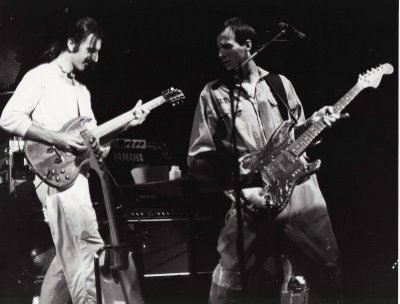
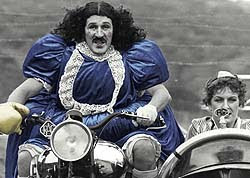
Longer interview with Chester Thompson with heavy focus on Genesis but also mentioning the Zappa years:
“Fans say, ‘You were part of the band.’ I was never part of the band… I was an employee. And all things come to an end”: Chester Thompson’s career in
and out of Genesis
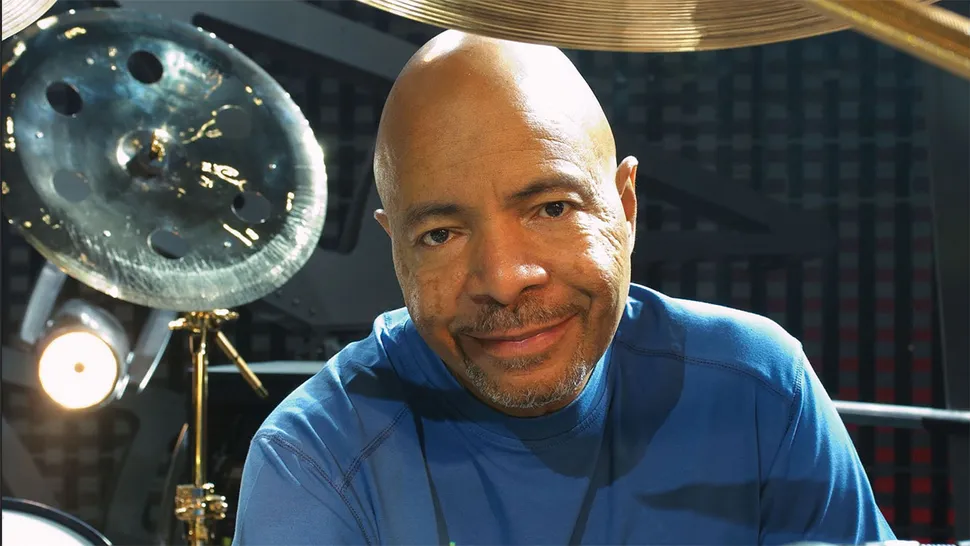
American drummer recalls his life and times with Frank Zappa, Weather Report, Phil Collins, Unitopia and even the Bee Gees
US-born percussionist Chester Thompson got his first gig when he was just 13 and his adult CV includes stints with Frank Zappa, Weather Report and,
more recently, Unitopia. Making his mark on the 70s jazz fusion scene, he soon became Genesis’ live drummer. Speaking to Prog, he shared some trade
secrets from his storied career.
n 2008, drummer Chester Thompson was honoured with the Sabian Lifetime Achievement Award by American body the Percussive Arts Society to mark a career
that began in Baltimore in the 60s when he was in his early teens. He honed his skills playing along to jazz records and went on to formally study
flute, percussion and composition.
He was about to embark upon a four-year degree course but instead joined Frank Zappa And The Mothers Of Invention in 1973, reckoning, “Well, this is
what I’m trying to get ready for anyway.”
Thompson played on a number of albums including Roxy & Elsewhere (1974), One Size Fits All (1975) and Bongo Fury (1975). He left Zappa to join
Weather Report, with whom he recorded Black Market (1976). Weather Report fan Phil Collins invited Thompson to join Genesis’ live line-up in late
1976.
The relationship lasted more than three decades, and Thompson features on their live albums from Seconds Out (1977) to Live Over Europe (2007). He
also drummed on all Collins’ solo tours and can be heard on releases from Steve Hackett, Tony Banks, and with Brand X’s John Goodsall in the Fire
Merchants.
Now living in Nashville, Tennessee, Thompson is a professor at Belmont University. His current projects include The Chester Thompson Trio, whose debut
album Approved made No.6 in the JazzWeek album charts in 2013. He has recorded with supergroup the Fusion Syndicate and joined the Australian prog
band Unitopia in 2021. In 2023 he released his third solo album, the melodic, funky jazz-fusion set Wake-Up Call, which also features his son Akil on
guitar.
When did you first realise you wanted to be a drummer?
My first clear memory is when I was 10 years old, which is fifth grade. But m mother once showed me a letter I wrote in fourth grade, and it actually
outlined my whole career – playing a big drum set and going all over the world in big bands. I have no memory of writing it and having that big
desire, but when I read it I absolutely wept.
Who were your early influences?
Jazz drummers – Max Roach, Art Blakey, Elvin Jones, and later, Tony Williams. I started very early. One of my brother’s best friends was a drummer. He
said, “You can come to the house and I’d be glad to give you a lesson or two.” Every morning at nine o’clock I was ringing the doorbell coming in for
a lesson!
When I was 13 someone called asking if he wanted to do a job with a local soul band. By then he had committed to playing jazz; so he put his hand over
the receiver and asked me, “Hey, you want a gig?” And I was like, “Well, of course!” And he said, “I can’t do it, but I’ve got a drummer. He’s 13, but
he can do it.”
I didn’t even have a drum set, so he took his drums down for me to do an audition with these guys, and they liked my playing. So my family got
together and we got a used drum set, and I started the next weekend – and played every weekend throughout school.
How did you get to play with Frank Zappa?
A friend of mine, Marty Perellis, had become Frank’s tour manager. He called and said that Frank had decided the band were playing the music so
perfectly, it had become a bit sterile. He was thinking of adding a second drummer – someone with, as he put it, more of a “street feel.”
For my audition we just jammed for about an hour, going from style to style; and he liked what I did. We started rehearsing, and for the first couple
of days we went over some simple things he’d just written. On the third day he brought the rest of the band and played through a bunch of the
repertoire. It was frightening – that stuff was so difficult and so crazy, I’m thinking, “What did I get myself into?”
But it was a great experience. Frank wasn’t known for it, but he was a great teacher. You had to be at a certain level to be in his band, but he knew
how to get you to the next level. That was my introduction to 40-hour-a-week rehearsals.
My first tour with Genesis, they gave me 10 days of rehearsal and decided to take a day off because it was going so well. That was frightening,
because that is not enough time to prepare for a two-and-a-half-hour show. But every Genesis tour, every Phil Collins tour, there was always a period
of 40-hour-a-week rehearsals.
What prompted you to leave Zappa to join Weather Report?
The very simple reason is Frank cancelled a tour. I had been in LA not quite two years, but we were always touring, so I hadn’t really had a chance to
meet many musicians there. So all of a sudden, I’m in this new city with no work. Alphonso Johnson, the bass player with Weather Report, had been a
friend of mine for many years. He mentioned that they were in town and looking for another drummer. They were my very favourite band at the time.
I went down and it ended up being an audition, and the next week they started rehearsing for a tour. I was just so in love with that music, so I let
Frank know, “I’m gonna be moving on.” And he understood – he knew it was my background. There was no animosity and we stayed friends.
Weather Report had a more organic feel than many 70s fusion bands, but then keyboardist Joe Zawinul and saxophonist Wayne Shorter had played with
Miles Davis on Bitches Brew. As composers they were always a bit left of centre – Wayne especially. Joe was from Vienna, Austria. He grew up doing
jazz and moved to New York at a pretty young age. But he was very much taken with music from other cultures, lots of African and Indian. And he heard
things in his head that were not traditional jazz.
When I first came into the band – before Black Market – we were talking about the drum parts that I’d put on different songs. They would never talk in
musical terms; once, Wayne said to me, “OK, with this song, picture being in a desert in a caravan.” That’s all he said, but I immediately knew what
he meant. Wayne and Joe were big film buffs; they loved movies and they always had a very visual bent to their compositions. I think they saw them as
more soundtracks than typical songs.
Phil Collins mentioned that the Genesis track Los Endos was inspired by Weather Report. But some British jazz-fusion musicians in the 70s were quite
deferential to their American counterparts, as if they didn’t feel they were quite the real deal. Did you come across that?
Yes and no. I’ve seen it with some. But then I’d meet John Goodsall and the guys from Brand X and they certainly didn’t have that feeling. Phil
invited me to come along to a couple of their recording sessions and just hang out, and I was very impressed, especially with Phil’s playing – and
also with Genesis, with all the odd timings of the early prog stuff. Boy, just really refreshing. Not your ‘typical drum part’ kind of guy.
I remember a conversation with Tony Banks. He was talking about the start of the band, saying, “We weren’t trying to be top-notch musicians; we just
wanted to play well enough to play the songs we wrote.” One of the big cultural differences I observed was that if you wanted to work – unless you
were in, say, California, or New York – you did cover songs, and you learned to play them exactly like that.
Coming to England, I started to recognise if you wanted to build up a following, even as a pub band, you had to have original material. I’d hear these
English groups and the playing wouldn’t be as pristine as, say, Miles Davis’s band – but the creativity would be absolutely amazing. Here in the
States, you would get these really tight bands, but not nearly as creative as what was coming out of the UK. So I think the answer may be somewhere in
there.
When you joined Genesis their material was essentially very English and some songs had a kind of whimsy, which was too much even for some English
people. How did you get on with that?
I’ve always been excited to go forward to the next thing, so I had to get used to the feel of it. It was much straighter and maybe metronomic in a way
than anything I’d done. I had played straight rock, but it’s still a very different feel. The use of bass was probably the biggest adjustment or me;
in everything I did, bass plays a very heavy role. With the early Genesis music bass didn’t carry the same kind of weight. Sometimes there would be
those Taurus bass pedals, so there’s a drone as opposed to an actual bass line.
On More Trouble Every Day from Zappa’s Roxy & Elsewhere, you and Ralph Humphrey play a syncopated two-bar drum break together a number of times
during the song. We understand that Phil Collins loved that break, so you two played it with Genesis.
It’s at the end of Afterglow on Seconds Out. At the first rehearsal, Phil and I were set up before the others, and we were just jamming. He suddenly
stops and goes, “How do you play the fill?” And I knew exactly what he was talking about. I taught it to him, as it takes two people to play it. When
one person is playing toms, the other’s on the bass drum and then you reverse it. I wish I had written it, but it was Ralph Humphrey.
The song I had the most trouble with was Afterglow, which is probably the simplest song. Phil would always say, “No, it’s not the right feel.” And I
finally asked him, “Where are you coming from?” He said, “Well, it’s like walking,” and he did a walking motion. And then I smiled inside because I
realised, “OK, there’s the problem. Where I grew up, we didn’t walk like that!” I played it with a bit of swagger, a bit of swing, and it needed to be
really straight. And that made a big difference in how I needed to approach a lot of the other things as well.
How did you and Phil work up the material for your live drum duets?
Basically from jamming. The first couple of tours, I pretty much did most of it. Phil, as much as he’d played, had not soloed as much. After that we
were very much involved together. At the end of rehearsals we would sit down and jam for a couple of hours. I would get my little cassette recorder
out and record it, and we’d pick out the bits we liked.
Were you basically given free rein in the songs?
Oh, absolutely. Phil would say, “These fills are part of the composition; the rest of it, you’re on your own. Just do what you feel.” So yeah, it was
a good working relationship. I had no intention or idea that it would go on for so many years – but they kept saying, “Would you come and do it
again?”
At one point, Phil said, “I think we need to bring you over early and do the recordings.” But they were friends, they all lived near each other, so
when they got an idea, they’d get together and get on it immediately. And by the time I could be flown in and get over jet lag, it’s done already. But
I knew what I signed up for so it was fine.
From their perspective, fans say, “You were part of the band.” I was never part of the band and the reality is that I was an employee, and what I did,
I tried to do it well. And all things come to an end.
Did you want to join the band as a full-time member just before Calling All Stations?
When I found out that Phil was leaving I did reach out to Mike Rutherford and asked if they were interested in continuing that way. He was like a very
hard-nosed, “No.” They had no interest in that whatsoever. It was “OK, fine.” I mean, I wasn’t hurting for work.
Had you hoped to play on The Last Domino Tour?
When Phil did the Motown tour in 2010, we had a really nasty falling out. I won’t go into detail, but I knew that nothing would ever happen after
that. I was actually very pleased to see that his son Nic got a chance to tour with him, as even at 5 years old the kid just had all the potential in
the world; you could see he was a natural. That’s it. I have nothing else to say on that.
You’ve toured with all sorts of bands. Do any memories particularly stand out?
I did a European tour with The Bee Gees in 1989 in between Genesis tours. In the States they got a bad rap with the disco thing – but they were still
writing incredible songs and it was a real pleasure to work with them.
The Santana thing was a lot of fun; that was actually a package tour with Bob Dylan. Prior to that I had recorded an album with Santana as well
[Beyond Appearances, 1985]. Alphonso Johnson was on bass, and there were two Chester Thompsons in the band – the keyboard player had the same name!
The Fusion Syndicate is an unusual project. On the 2023 album A Speedway On Saturn’s Rings you recorded one track, Io, with Rick Wakeman, and another
with Jah Wobble on bass...
It’s never really been a band. All the basic tracks were done in two days by me and a bass player in LA, knowing they would bring in guest artists on
different tracks, including several different drummers. A fusion all-stars, for lack of a better term. I don’t like to listen to my playing that much,
so I still haven’t heard all of it. I’ve done several things for them [Cleopatra Records and sub-label Purple Pyramid] where they will put together a
fusion or prog project. I ended up playing on a King Crimson tribute [Schizoid Dimension] as well.
You and Alphonso Johnson joined Unitopia and played on last year’s Seven Chambers.
Man, I really enjoy that band. We did a European tour in September and we’re hoping to be able to book another tour soon. They took a hiatus from
recording and touring [from 2014 to 2021]. The main two guys, Sean Timms and Mark Trueack, have added a very good guitarist, John Greenwood –who’s a
retired surgeon, actually.
They’ve been doing most of the writing, so we’re all throwing our bits in as we go. For the next one they want to really co-write it; trouble is, you
got a couple of guys in Australia and Mark now lives in Thailand. We’re all over the map!
How did you put the music together for Wake-up Call?
The bass and keyboard player and the bass player [Michiko and Robert ‘Peewee’ Hill], were in the first band I ever had. We just used my name as we
could never decide on a name. Unfortunately, the band never got to be what it could have been, but we all stayed close. The crazy part is we haven’t
played together in 30 years, but the feeling we had when we played together is still there.
I spoke with them at the beginning of lockdown. They have a home studio and were saying, “Nobody’s booking the studio, so we’re just sitting around
jamming with the drum machine.” And my comment was, “No, don’t do that. Let me send you something to jam with.”
I laid down a drum track – not quite five minutes – and I threw in some fills. When I’m jamming alone, I’m hearing melodies in my head. They wrote
around it and sent it back to me and it totally blew my mind. I was like, “You gotta be kidding me!” And their comment was very flattering. They said,
“We just went where you led it.” But then, we put a lot of time together back in the day. It stretched out for about a year with them writing around
the drum tracks I sent. So then we started adding in some saxophones and guitars.
How often do you practise?
If I haven’t played in three or four days I start getting really antsy. For me, at this point in life, some of the practice is to not lose what I’ve
had. I’ve slowed down a bit from when I was 25-30, but there’s not much of it I can’t do. I’m grateful for that and I want it to be crisp; I want it
to be what I intend.
But I’m always looking to learn new stuff. I still believe very much in practising music, just like they always speak of practising medicine and
practising law. You practise music because you will never know everything. And the moment you think you do, you’re finished.
Mike Barnes
Mike Barnes is the author of Captain Beefheart - The Biography (Omnibus Press, 2011) and A New Day Yesterday: UK Progressive Rock & the 1970s
(2020). He was a regular contributor to Select magazine and his work regularly appears in Prog, Mojo and Wire. He also plays the drums.

 Search
 FAQ
FAQ Member List
 Today's Posts
 Stats
Stats Board Rules


 and
and